
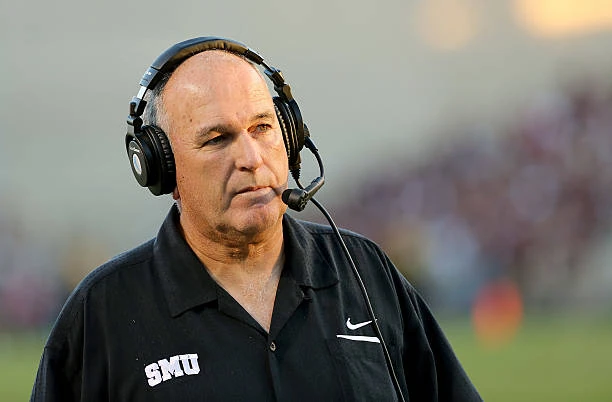
DALLAS — June Jones, the innovative football coach who transformed Hawaii into a national powerhouse, resurrected SMU’s struggling program and helped revolutionize passing offenses across multiple levels of football, died Thursday at age 73.
His death was announced October 29 by Run & Shoot Certification, the coaching organization Jones helped establish. A cause of death has not been officially disclosed.
“We mourn the passing of the legendary June Jones,” the organization said in a statement.
MORE: Bears Land Jeffery Simmons in Blockbuster Trade With Titans
For more than four decades, Jones built a reputation as one of football’s most influential offensive minds. His commitment to the run-and-shoot offense challenged traditional coaching philosophies and helped establish passing concepts that remain prominent throughout modern football.
But his greatest achievements weren’t simply found in complicated playbooks or record-setting passing statistics.
They came from rebuilding programs that had nearly forgotten how to win.
Jones inherited a Hawaii team coming off an 0-12 season when he became head coach in 1999. One year later, the Rainbow Warriors finished 9-4, completing what was then the greatest single-season turnaround in NCAA football history.
He would compile a 76-41 record over nine seasons, becoming the winningest coach in the program’s modern history.
His crowning achievement came in 2007, when Hawaii finished the regular season undefeated at 12-0 behind record-setting quarterback Colt Brennan.
Brennan emerged as a Heisman Trophy finalist, and the Rainbow Warriors earned their first Bowl Championship Series appearance before falling to Georgia in the Sugar Bowl.
Jones also helped develop quarterback Timmy Chang, who became college football’s all-time passing yardage leader during his playing career.
Following his success in Hawaii, Jones accepted another daunting challenge at SMU in 2008.
The Mustangs were still struggling to recover from the NCAA’s infamous 1987 death penalty and hadn’t reached a bowl game since 1984.
Jones needed just two seasons to change that.
SMU defeated Nevada 45-10 in the 2009 Hawaii Bowl, ending a 25-year postseason drought. The Mustangs subsequently made four consecutive bowl appearances from 2009 through 2012.
Jones finished 36-43 at SMU before resigning early in the 2014 season.
His professional coaching career was equally extensive.
Jones served as head coach of the Atlanta Falcons from 1994-96, leading the franchise to the NFL playoffs in 1995. He later worked as interim head coach of the San Diego Chargers and coached in the Canadian Football League and XFL.
In 2020, his Houston Roughnecks opened the XFL season 5-0 before the league suspended operations because of the COVID-19 pandemic.
Across his college coaching career, Jones compiled a 112-84 record while influencing generations of quarterbacks, receivers and offensive coordinators.
His offensive system, developed through his association with run-and-shoot architect Mouse Davis, emphasized quick reads, receiver option routes and attacking defensive coverage through the passing game.
Those principles helped shape an era in which spread formations and sophisticated passing attacks became central to football at virtually every level.
Despite his considerable success, those who knew Jones emphasized his influence beyond the field.
MORE: Flagg Dominates as Mavericks Crush Thunder 120-96 in Dallas
“June’s greatest legacy wasn’t the records, championships, or the offense,” Run & Shoot Certification said. “It was the people he believed in, the opportunities he gave, and the lives he forever changed.”
For Hawaii fans, he’ll forever be remembered for the magical 2007 season. For SMU supporters, he was the coach who restored hope to a once-proud program. And throughout football, he’ll be remembered as an innovator who helped change how the game is played.
June Jones didn’t just win football games.
He helped redefine what an offense could become.





0 Comments